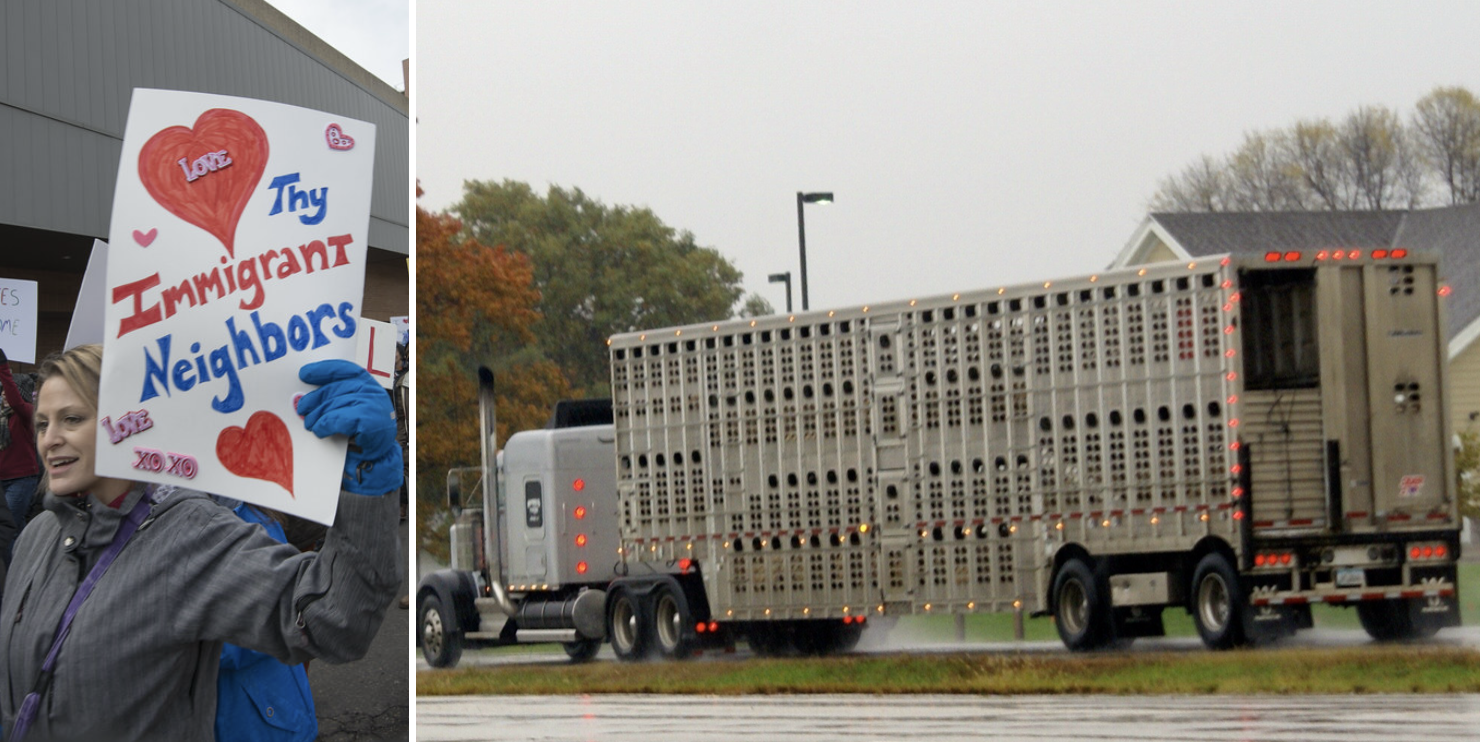
Religious Resettlement Agencies Funnel Refugees to Exploitative Slaughterhouse Work
Starting in the 1980s U.S. religious organizations began to take over the government’s role in resettling refugees, often in dangerous and underpaid slaughterhouse and meatpacking jobs. The Refugee Act of 1980 reshaped U.S. policy toward refugees by aligning it with international standards, creating the U.S. Office of Refugee Resettlement, and establishing a formal resettlement process that increasingly relied on public-private partnerships with existing religious service networks.
Religious Resettlement Privatizes Refugee Services
Of the 10 current U.S. resettlement agencies with formal agreements through the UN’s High Commission for Refugees, seven are explicitly religious, including (1) Church World Service, (2) Episcopal Migration Ministries, (3) Hebrew Immigrant Aid Society, (4) Global Refuge (Formerly Lutheran Immigration and Refugee Services), (5) United States Conference of Catholic Bishops (USCCB), (6) World Relief Corporation, and (7) Bethany Christian Services, for a total of six Catholic/Christian- and one Jewish-based organization/s.
On one hand, these religious resettlement agencies—or RRAs—position themselves as responding to the prophetic biblical call to welcome the stranger in communities of justice, “for you were also strangers” (Deuteronomy 10:19). On the other hand, the work of RRAs aligned neatly with a political call from George H. Bush’s 1989 “thousand points of light” campaign to privatize public services—a year later transitioned to the nonpartisan Points of Light Foundation—wherein a “neighbor can help a neighbor,” rather than raise or redistribute governmental taxes for refugee aid.
The process of resettlement relies heavily on private partnership between the 10 resettlement agencies and their 360 officially listed local affiliates (as of August 2025), over 70 per cent of which are religiously based. For individuals who make it through the United Nations’ lengthy approval process, resettlement agencies arrange travel to the U.S. and use funds from the Office of Refugee Resettlement (ORR) to provide 90-day post-arrival support for basic orientation in a new town, initial housing and healthcare access, English classes, and social security card applications. These same organizations can raise additional donor funds for an ORR Matching Grant to help refugees gain employment within 240 days of their arrival, the point when they are expected to be economically self-sufficient without public assistance.
During this period, RRAs access their own networks of community partners, congregational volunteers, and individual donors to fill the gaps—from furnishing apartments and groceries to counselling classes, from offering rides to skills training.
RRAs also partner with local employers in need of workers. Because meatpacking and slaughterhouses do not require English skills, refugees are more easily funneled to these jobs. Additionally, slaughterhouses have chronic demand for employees due to high turnover attributed to low wages, increased injury rates, and psychological distress that American workers are unwilling to accept.
Colluding with “Big Meat”
Partnerships between meatpacking plants and RRAs are initiated by various parties. First, “Big Meat” companies such as Tyson, Cargill, JBS-Pilgrim, Smithfield, and Perdue practice indirect human resources outreach to resettlement affiliates by offering vehicle and transportation donations, cash gifts, community and healthcare improvements, and refugee liaisons. Direct incentives include offering workers (or their children) tuition-free rural education for trade schools or community college, signing bonuses, housing assistance, and childcare services.
Second, RRAs and their affiliates seek and support meatpacking partnerships. As one World Relief refugee-turned-staffer reports, “When I first started, XPAC and Tyson were the main companies where we’d take clients to get a job. . . [they] are two of our longest running partnerships.” Episcopal Migration Ministries’ 2021 annual report lists Smithfield and Tyson as primary partners (p. 13). In 2016, Tent Partnership for Refugees was launched by the CEO of Chobani foods in collaboration with Lutheran-based Global Refuge to match businesses with refugee labor; Tyson and Cargill are major members of Tent.org, committed to hiring 3500 total workers from 2022-25 through resettlement programs. HIAS, previously known as Hebrew Immigrant Aid Society “founded by Jews to help fellow Jews” in 1870, now offers resettlement services for refugees of all ethnicities; in their printable talking point guidance for supporters contacting political candidates, HIAS emphasizes refugees’ economic contributions to “hospitality and meatpacking . . . especially in rural areas.”
Third, meatpackers depend on word-of-mouth invitation from co-ethnic workers or clergy inviting newer arrivals to join their community and workplace. These “secondary-migration” sites—usually from urban to rural locales—promise plentiful low-skill jobs, common language communities, affordable housing, and entrepreneurial opportunities. To meet the challenges of increased refugees in these secondary sites, the U.S. Office of Refugee Resettlement itself sponsored a pilot program with RRAs to explore funding new offices in rural areas, specifically noting regions where slaughterhouses attracted under-served refugees.
Perpetuating a Vulnerable Workforce
The ruralization of U.S. meatpacking follows well-documented cycles of workers’ seeking labor gains in urban centers followed by union-busting practices. Starting in the 1950s, meat production shifted toward inexpensive rural land and modernized facilities closer to livestock sources. This move also enabled access to cheaper, less-skilled, non-unionized labor, with the additional effect of vitalizing rural areas with business growth and population diversity that RRAs now celebrate and reinforce through additional resettlement.
In the small town of Monmouth, Illinois where I was a professor and conducted research on industrial agriculture from 2014–17, at least 14 languages were spoken on the kill floor of the Monmouth pork plant, according to my conversation with human resources director Michelle Reyburn in 2016. Now owned by Smithfield, which was purchased by a Chinese company in 2013, the Monmouth plant runs 24 hours a day except Sundays, and is staffed by a diverse international workforce that exterminates 12,000 pigs—acknowledged as highly intelligent and sensitive animals—every day so that consumers across all demographics can enjoy a shared love of cheap bacon. Software companies like Missouri-based WorkForge now produce slaughterhouse training materials in 10 languages and counting to help reduce the perpetual turnover.
Spanish is only one of these languages. Mexican immigrants certainly filled many of the early anti-union vacancies, driven, in part, by agriculture displacement throughout Mexico due to NAFTA, and by networks of Mexican “boxcar” families descendant from immigrant railroad workers who’d lived in the Midwest since the early 1900s. When December 12, 2006 brought the first large-scale coordinated immigration raids in U.S. history to rural slaughterhouses, visa access for more compliant refugees and seasonal workers was accelerated through religious resettlement organizations tracking waves of global instability. Bosnian Muslims and Catholic Croatians came to Monmouth and other Midwest cities, escaping the genocide that followed the breakup of Yugoslavia. Asylum seekers from Africa and the Middle East—Eritrea, Somalia, Sudan, Benin, Burundi, Ethiopia, Cameroon, Syria, and Iraq—as well as a fast-growing community of Burmese Christians fleeing the Buddhist government of Myanmar settled in various towns with slaughterhouses offering shifts for non-English speakers. In the last decade, refugees from El Salvador, Haiti, Nicaragua, and Venezuela are guided by resettlement groups to meatpacking plants through the Temporary Protected Status (TPS) designation, ostensibly as a “legal” workforce immune from immigration harassment. The Center for Economic and Policy Research report that 51.5% of frontline meatpacking workers are foreign-born and Fiscal Policy Institute ranks slaughterhouse work as the fifth highest concentration of refugee labor behind nail salons, manufacturing, taxi and truck driving.
Trump’s Refugee Ban Offers a Reflection Point for Responsible Resettlement
Awareness is slowly dawning as to how the U.S. government utilized RRAs and affiliate religious communities to perpetuate what Karl Marx called a “reserve army” of the unemployed in an unjust replacement cycle of relocation and deportation of vulnerable workers. In Spring 2025, Episcopal Migration Ministries, Church World Service, and U.S. Conference of Catholic Bishops voted to end their government partnerships by the end of the year in response to the Trump administration freezing current resettlements and ending multiple refugee aid programs while fast-tracking a group of South African farmers to skip the line. The belief that American workers will fill the jobs left by blocked migration and mass deportation of TPS workers while the government also eliminates collective bargaining power and slaughterhouse inspectors is a fiction with which many states are coming to terms, since it will likely lead to corporate automation and the continued death of small- and medium-size farming operations.
Even as religious refugee resettlement organizations break away from decades-long governmental contracts, they maintain their commitment to assist refugees. At present, this pivot requires a redoubling call upon parishioners and donors to shoulder increased burdens from lost funding. Similar outsourcing programs, such as Welcome Corps—started by the U.S. Department of State under President Biden—invite businesses or private groups of five or more citizens to mirror the work of religious resettlement agencies by providing the required 90-days of sponsorship to individual refugees. Although this program was terminated by the Trump administration concurrent with the suspension of refugee admissions in February 2025, it suggests a future of renewed private refugee sponsorship that will require employment partners. Ultimately, this problematic pause in refugee programs offers an opportunity for religious resettlement organizations and private groups to reconsider, not only what it means to welcome the stranger as one in 67 people on earth are forcibly displaced, but also to reconsider the troubling trend of funneling refugees toward exploitative and dangerous labor cycles in the violent production of American meat.
Feature Image: Pigs en route to the slaughterhouse in Monmouth, IL; credit B. Donaldson. Caravan of Love walk in support of immigrants and refugees; credit Fibonacci Blue


About Author/s