Between Fear and Hope: An interview with Ayat Altaii
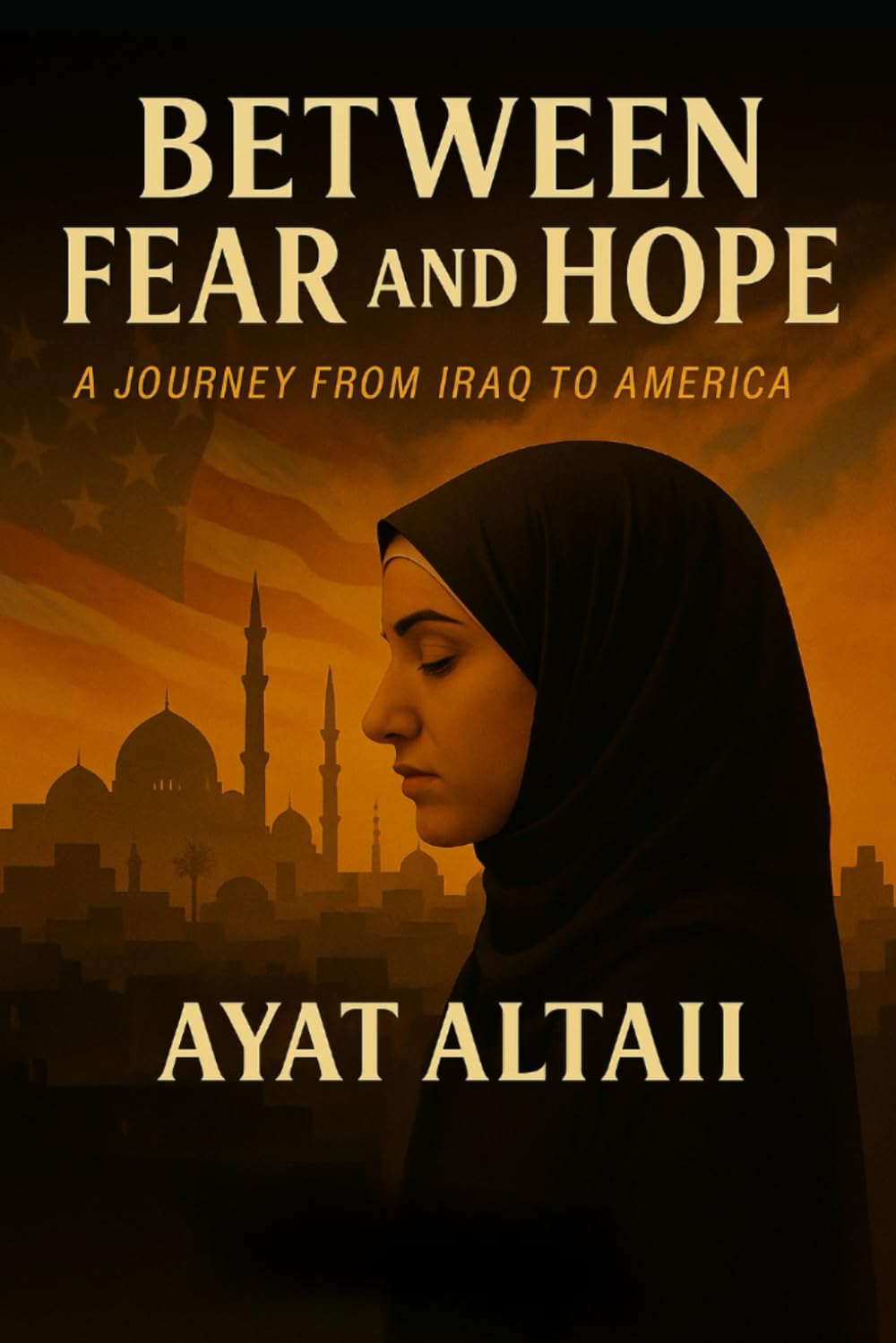
Ayat Altaii has recently published the first volume of her memoir ‘Between Fear and Hope: A Journey from Iraq to America‘. Refugee Research Online spoke to Ayat about her book.
Mark Rainey: Thank you for taking the time to speak with Refugee Research Online today and thank you for writing this book. It’s wonderful. Each chapter is concise and compact, yet full of meaning, depth and emotion. What do you see as the key message of your book?
Ayat Altaii: So, with this book, my heart is on the papers. The message is simple, but deeply personal. Even in war, even in displacement, even when the world tells you that you’re invisible, you can survive. You can still find hope. I did not write this to be famous or to show off or to make myself look strong. I wrote it for my future children, so they will know where their mother came from and understand her journey. I also wrote it for every single refugee child who lies awake at night, scared, wondering if tomorrow will be worse. And I wrote it for people who have never lived this life so they could see us as human beings. Not just numbers in the news, but people with dreams, fears and love.
MR: Early on the book you describe your childhood in Baghdad amid escalating violence and chaos. You write about how important attending school was for you at the time, despite the world, in your words, ‘burning outside the school gates’. A young teacher tells you something simple but profound: ‘Keep showing up, Aya. That is enough’. This seems to be an important motto for you. What does it mean to you? Is writing this book another way for you to ‘keep showing up’?
AA: ‘Keep showing up’. It means refusing to disappear even when life tries to make you small. When I was young a teacher told me those words at a time when even going to school felt dangerous. At first, I thought it just meant walking into the classroom, but now I understand it means showing up for yourself, for your truth. It means showing up for the people who can’t speak out. I’ve always been the kind of person who keeps pain locked inside. Talking about my past was terrifying, I’m going to be honest. But this book gave me the courage to release it to all people. I wrote it for the child I was, for the children who are too afraid to speak, and for my future children, so they will never have to wonder if their mother stayed silent one day. And also my fiancé, Osamah. He helped me a lot. He encouraged me on the days I felt weak. He reminded me that telling my story was not selfish. It was necessary, you know? But without his support, this book might have stayed inside me, not even written.
MR: It must take some courage to write this book. Like you said, it involves support from other people. Can you describe how you motivated yourself?
AA: My fiancé, he’s the one who encouraged me. I’m always silent. I don’t like to speak to other people. I don’t like to tell what’s inside me. But the minute I met him was the minute I got more challenged and less afraid of anyone. He always tells me: ‘Do this. Do this. Be brave and make sure you do this’. So, I was just like, ‘you know what? Let’s write the whole book’. His love, encouragement and patience helped me through the hardest parts of writing this book. There were days when I did not believe I could do it, but he always reminded me of why my story mattered.
MR: From the outset of the book you talk about yourself having two names: Ayat and Aya. The first is the girl in Baghdad holding tightly to her mother’s hand. The second is the girl who crosses borders. It’s a protective name used in places you felt different. This reflection on different names leads into so much about the migrant and refugee experience. It is about adaptation, tenacity and belonging. How do these different aspects of you inform your writing? How do they appear in the text?
AA: Ayat is the little girl who was clenched to her mother’s hand in Baghdad walking through chaos and fears. But Aya is the girl who crossed borders, adapted to a new world and learned how to survive in it. In my writing, they were both alive. Ayat brings the raw memories, the truth of what happened. But Aya brings the reflection, the growth, and the ability to see it all from a distance. Together, they all tell the story, fully. Even now, I live with both of them. Ayat keeps me grounded in my roots, but Aya pushes me to keep going. And Osamah, my fiancé, loves both parts of me: the wanted girl, and the strong woman I’ve become.
MR: The title of your book is ‘Between Fear and Hope’. What does it mean to live between fear and hope? How does this relate to the wider migrant experience and those who face displacement and seek refuge in another country?
AA: ‘Between Fear and Hope’ means carrying two worlds inside you. Fear is waking up to bombs, soldiers, and borders that won’t let you through. But hope is believing there’s still something better ahead, even when you cannot see it yet. Fear shaped my childhood. But hope kept me alive. I found it in my mother’s prayers, in teachers who believed in me and in strangers who showed kindness. That balance between fear and hope is the refugee experience. We live in the middle of both every single day. It’s even the same in love. When I met Osamah, my fiancé, I carried fears from my past. But hope told me it was possible to find a safe person. Even in him, I found it. I did, definitely.
MR: You mentioned your teachers. In the book education is so important for you. It shines through the writing whether in Baghdad or San Diego. It is part of the hope you describe?
AA: Yes, it was part of my hope. I’ve always loved to learn. I’ve always loved to go to school and learn and go to college, receive my degrees and become a preschool teacher. I’ve always wanted to become a preschool teacher because I love kids. Since I was little, I just loved kids, even till now. But because my life changed, I couldn’t be a preschool teacher. But I’m still learning and all of that is a part of my hope, yes.
MR: Aside from the book what have you been doing?
AA: Right now, I’m applying for my master’s degree and I have my own business. And I’m helping my family and their business. Most importantly, I’m working on the second volume that will explode the whole world.
MR: That leads to my next question. What’s next with the book? Because this is just the beginning of the story, isn’t it?
AA: Yes. So, this book ends in middle school, because that’s where the first chapter of my life in America began. But so much more happened after that. Graduation from college. Starting my business. And most importantly, meeting my fiancé. He was with me through the writing of this book. He encouraged me to share all the parts of myself that I had never spoken about at all to any person. In the second volume, I will be telling our story. How we met, how our love grew across long distance, and how we worked through every challenge to finally get engaged. It’s a powerful story of patience, faith and finding peace after years of uncertainty. So you will find a lot of stuff in the second volume. It’s way more powerful than the first one, because a lot of stuff happens.
MR: I look forward to it. When would we expect to see the next volume? No pressure to write it!
AA: Hopefully next year.
MR: Thank you again for writing this book.
AA: Thank you for giving me the space to share my story today. The book is pieces of my past that I never thought I would be brave enough to speak out loud. It’s the voice of the little girl I used to be and the women I’ve grown into right now. To anyone who is going to read this interview: refugee stories are not just headlines. They are humans with hearts beating between fear and hope and sometimes they’re full of love, too.


About Author/s