Applying Modern Monetary Theory to the Housing Needs of Internally Displaced Persons in Colombia
Housing is recognized as an essential element of human dignity. Article 25 of the United Nations Declaration of Human Rights affirms that everyone has the right to “a standard of living adequate for health and well-being,” including housing. The International Covenant on Economic, Social, and Cultural Rights (ICESCR) expands this definition by emphasizing the importance of affordability, habitability, accessibility, and security of tenure. These elements link housing to a person’s stability, safety, and the ability to participate fully in society. However, when housing is treated as a market commodity, these elements of well-being are undermined. This often results in what Leilani Farha explains is a persistent “pattern of homelessness, overcrowding, evictions, and extreme rent burdens that directly violate internationally recognized human rights standards”. While housing exists as one of the most basic conditions for a stable and dignified life, millions of people around the world, especially forced migrants and internally displaced persons (IDPs), continue to live without adequate shelter.
Colombian IDPs’ Need for Housing
In 2024, 123.2 million people worldwide were forcibly displaced of which nearly 73.5 million were classified as internally displaced persons (IDPs). According to the United Nations High Commissioner for Refugees (UNHCR) Colombia “has the world’s second-highest population of internally displaced people, with an estimated 6.8 million Colombians displaced within its borders.” There are two categories of forced displacement: reactive displacement occurs “as a consequence of direct exposure to violence,” whereas preventive displacement occurs “when individuals migrate to avoid victimization that has not yet occurred”. Colombian IDPs face both forms of displacement, making them victims of direct violence and forced displacement.
The massive internal displacement within Colombia is due to continued violence between armed groups in different parts of the country. These groups perpetuate many human rights violations, including forced confinement, “a widespread practice where armed groups lock down entire villages, warning residents not to leave the confines of their settlement under threat of death or other forms of retaliation.” Armed groups exercise extreme control over these communities, whether that be the extortion of local businesses, control over crop farming, or influence on the resolution of interpersonal matters between neighbors. In doing so, the armed groups cause instability on social, political, and financial levels within communities and hence cause forced displacement among Colombians.
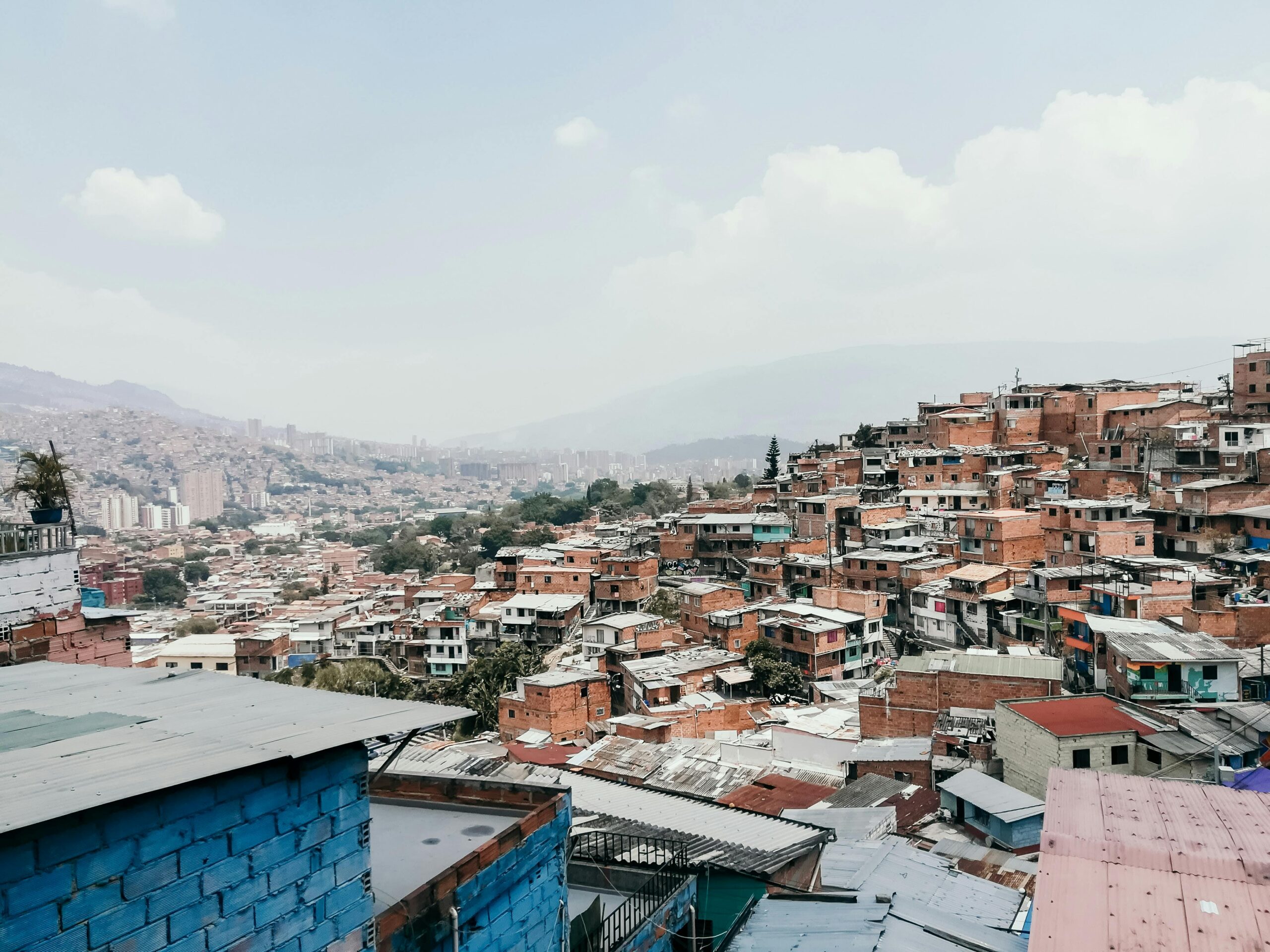
IDPs are forced to disperse throughout Colombia’s different regions, with most residing “in impoverished metropolitan areas [that are] thoroughly intermingled with other types of victims or armed conflict”. Fearing further discrimination or persecution, many IDPs residing in urban communities disguise their IDP status. The urban settings IDPs live in are “characterized by widespread community violence at the hands of gangs, criminal bands, and urban-dwelling tentacles of the guerilla and paramilitary groups whose rural counterparts perpetrated their displacement”. Therefore providing housing that guarantees safety for IDPs is essential to the success of their wellbeing.
Continued violence between armed groups complicates the efforts for IDPs to find safe and sustainable housing, especially those dispersed throughout rural communities. For example, on January 16, 2025, violence between multiple armed groups broke out in the Catatumbo region, which forced “more than 50,000 people from their homes and trapped another 21,000 in their communities.” This resurgence of violence has left communities completely cut off from any humanitarian assistance. Therefore, it is crucial for the Colombian government to intervene and provide protection – including safe housing – for IDPs.
Modern Monetary Theory (MMT) and the Government’s Responsibility
Although governments often claim that large-scale public investment is financially unrealistic, the framework of Modern Monetary Theory (MMT) challenges this assumption. MMT argues that currency-issuing governments are not constrained by traditional budget limits in the same way household or local governments are. Moreover, in his book, MMT economist Randall Wray argues that governments that issue their own currency do not rely on tax revenue to spend; rather, they create money through spending itself. In other words, taxes are tools for managing inflation, not for funding government programs. Therefore, if governments are not financially constrained in the manner households are, then large-scale public housing becomes possible.
To implement this, the government can directly finance construction of new public or social housing units. Due to the constraint not being financial, these projects can be scaled to meet the true level of need without fear of increasing deficits. For the dispersed populations of IDPs in Colombia, this option would increase accessibility throughout rural communities. The government also has the option of acquiring and renovating vacant properties for housing, an option that would accelerate accessibility to housing for IDPs in urban communities. MMT also supports long-term funding for programs like Housing First, which prioritizes providing permanent housing and support services to people experiencing both chronic and temporary homelessness. Applying Housing First to Colombia can give IDPs access to housing when resurgence of violence between armed groups arises in a community. Viewing housing through an MMT lens not only reframes what is financially possible but also strengthens the argument that housing should be treated as a fundamental human right.
‘Forcibly displaced people’ is an umbrella term encompassing several legal statuses in which each has its own set of protections and benefits. IDP’s protection under international law is minimal at best. Instead, the protection of IDPs “is the sole responsibility of national governments, which brings additional challenges because they are facing war, conflict, or intense violence”. Therefore, the government of Colombia has an obligation to protect the welfare and safety of IDPs throughout the State. The government of Colombia needs to institute policies to combat the structural violence that initiated and perpetuates the internal displacement crisis. Therefore, under MMT’s economic feasibility, the Colombian government should implement a universal housing program for IDPs. Providing stable housing as a first step will allow for IDPs to experience safety that will permeate all other aspects of their lives, including access to community, education, jobs, and healthcare. That said, as Colombia is approaching ten years since the 2016 peace agreement, enduring peace and security will not last until the government addresses IDP’s housing disparities.


About Author/s