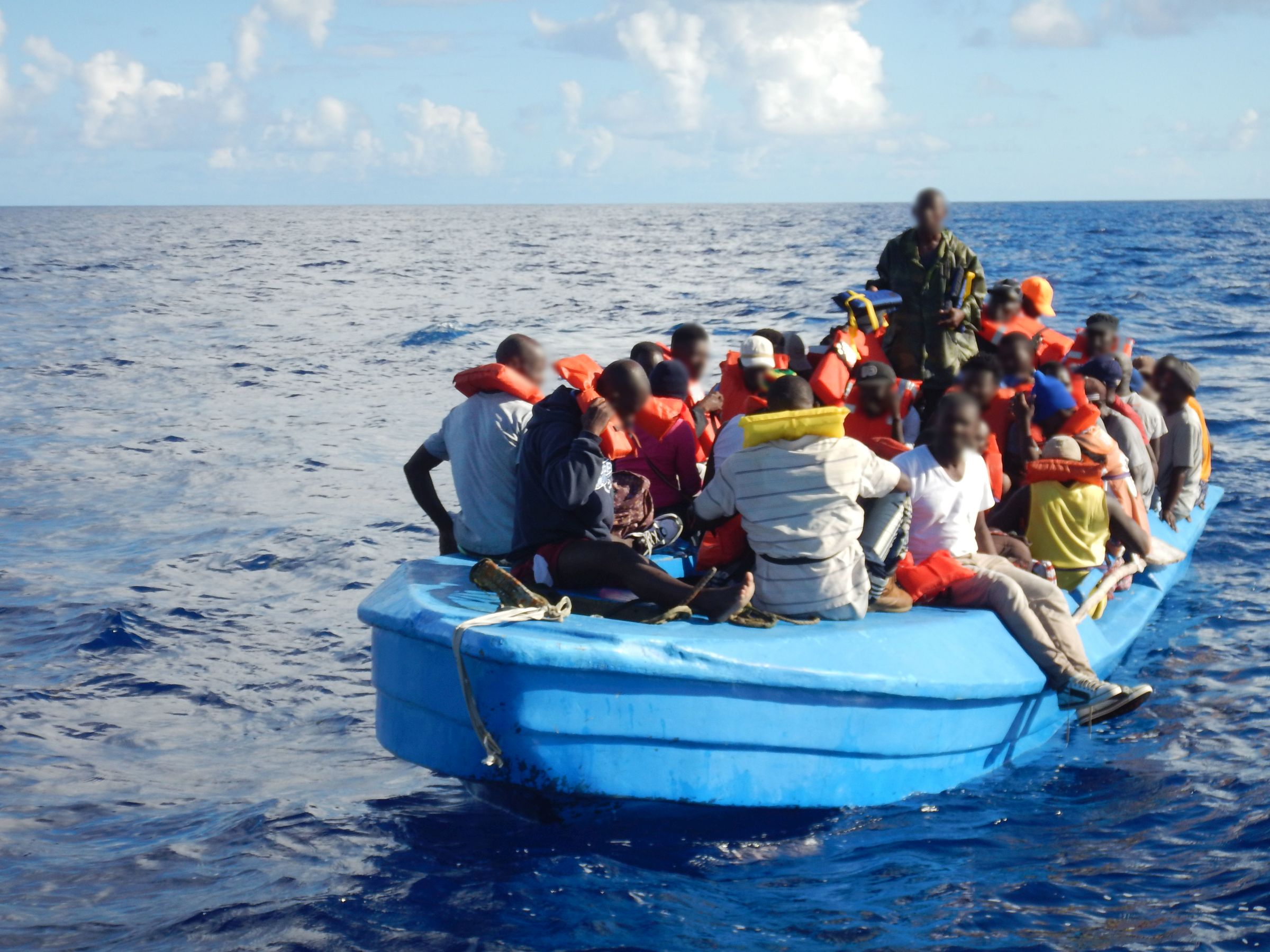
Suffering for Security: How the Refugee Crisis Leaves People Vulnerable to Human Trafficking
This blog piece from, M.A student Meaghan Phillips, is calling for the expansion of the definition of persecution within the 1951 Refugee Convention and for protections to be added to the Palermo Protocol.
————————————————————————————- —————————–
As many know, mass migration is a topic in almost every current international political conversation. With large amounts of refugees fleeing climate issues, persecution, war, and famine there is displacement that hasn’t been seen since World War II. This has led people to be susceptible to criminal networks to provide them with travel during their forced migration. While international legal frameworks such as the 1951 Refugee Convention and the United Nations Protocol to Prevent, Suppress and Punish Trafficking in Persons (Palermo Protocol) should offer certain protections, many of these are under attack by political campaigns and outdated definitions. Therefore, the international system must examine how the refugee crisis plays a role in human trafficking and adapt the Palermo Protocol protections and expand the definition of the 1951 Refugee Convention to better respond to this crisis.
There is a current refugee crisis, with the United Nations High Commissioner for Refugees claiming as of June 2025, 117.3 million people have been “forced to flee their homes globally due to persecution, conflict, violence, human rights violations or events seriously disturbing public order” and within that number 42.5 million refugees. This means 42.5 million people in this year were susceptible to human trafficking. In order to understand this, we must understand trafficking “within the context of international and national movements and migrations that are increasingly occurring due to economic realities, globalization, the feminization of migration, armed conflict, the breakdown or reconfiguration of the State, and the transformation of political boundaries” as well as how the dark economy benefits (Manjoo 2014 p.7). The dark economy is the international criminal network mostly known for the drug trade. When there is a surplus of people who need security combined with a huge media campaign against immigration and refugees as being seen in North America, this causes criminal networks to step up as a transportation service. This dark economy profits off the vulnerability of refugees looking for security and transportation and can lead to forced labor, sexual exploitation and other forms of slavery. While there are protections for refugees in the 1951 Refugee Convention, it lacks defining this issue of vulnerabilities that lead to trafficking. In the same vein, the Palermo Protocol, while criminalizing human trafficking, lacks protections for refugees. Therefore, there needs to be protections that address both issues and the systems that cause the dependence on criminal networks.
First, legal protections that can address the holes in international law are the Refugee Convention and the Palermo Protocol. The 1951 Refugee Convention needs to be updated. There have been critiques that this statute does not address many modern issues including climate refugees and trafficking. Specifically in this instance, it must cover the vulnerabilities that refugees have that leave them open to trafficking and condemn trafficking, which can be done by labeling trafficking as a form of persecution. This would allow for refugees in these scenarios to access resources and protections the framework protects. In addition, the Palermo Protocol can also establish protections for refugees which would allow these two doctrines to be used together to protect refugees legally. For the systems that cause dependence on criminal networks, it is important to understand that many states lack the resources or political will to protect refugees from human trafficking. One of the reasons that political will is a problem is this huge push from right-wing groups on fear-mongering campaigns surrounding migration. A huge example of this was the campaign that Islamic State of Iraq and Syria [ISIS] was hiding amongst refugee camps during the 2016 refugee crisis to demonize the refugee camps and cause public outrage on whether to take the refugees into their country. This kind of language is extremely harmful especially when “it is often overlooked in current media debates that refugees and migrants are not only people in search of human security, and thus in need of protection and basic shelter, but are also individuals with diverse potential, skills, education, and capacity to contribute. They long for a peaceful future that is free of violence and want to build their lives in new settings and make their own living” (De Silva 2017 pg. 107). Therefore, there needs to be a change of media language towards refugee policies. There needs to be emphasis on the need for security, a reminder of human rights protections such as the 1951 Refugee Convention and the Palermo Protocol and fact checking done on these media campaigns. The media should focus on humans within these conflicts, not political agendas.
Ultimately, the refugee crisis will not be solved by one state alone. It will require media campaigns, cross cultural and cross state negotiations and solving deeper rooted systems that are breeding conflict. As a society, we must focus on actionable items we can do currently to help prevent more vulnerabilities for an already vulnerable population. We must add protections for refugees in the Palermo Protocol and expand the definition of persecution in the 1951 Refugee Convention. Most importantly, we must humanize these issues as no one should be forced into suffering while looking for security.
References
De Silva, Purnaka. 2017. “Regional Impact of Human Trafficking and Forced Migration: Looking for Solutions in Libya .” Taylorfrancis.com. 2017. https://www.taylorfrancis.com/chapters/edit/10.4324/9781315538129-12/regional-impact-human-trafficking-forced-migration-purnaka-de-silva?context=ubx&refId=355dc5c8-0e07-4e72-8a90-e6c8c70bcc01
Human Rights Watch. 2016. “Dispatches: Fearmongering about Refugees.” March 4, 2016. https://www.hrw.org/news/2016/03/04/dispatches-fearmongering-about-refugees.
Manjoo, Rashida. 2014. “TRAFFICKING of WOMEN: NORMS, REALITIES, and CHALLENGES.” https://www.albanygovernmentlawreview.org/article/23925-trafficking-of-women-norms-realities-and-challenges
Oshin Johari 2024. “DEFENDING HUMAN RIGHTS in the FIGHT against HUMAN TRAFFICKING and REFUGEE EXPLOITATION – LIJDLR.” LIJDLR – India’s Most Indexed Legal Journal in Global Databases. September 24, 2024. https://lijdlr.com/2024/09/25/defending-human-rights-in-the-fight-against-human-trafficking-and-refugee-exploitation/.
United Nations. 2000. “Protocol to Prevent, Suppress and Punish Trafficking in Persons Especially Women and Children, Supplementing the United Nations Convention against Transnational Organized Crime.” OHCHR. United Nations. 2000. https://www.ohchr.org/en/instruments-mechanisms/instruments/protocol-prevent-suppress-and-punish-trafficking-persons.
UNHCR. 1951 “The 1951 Refugee Convention.” UNHCR. https://www.unhcr.org/about-unhcr/overview/1951-refugee-convention.
UNHCR. 2024. “Figures at a Glance .” UNHCR US. 2024. https://www.unhcr.org/us/about-unhcr/overview/figures-glance.


About Author/s